

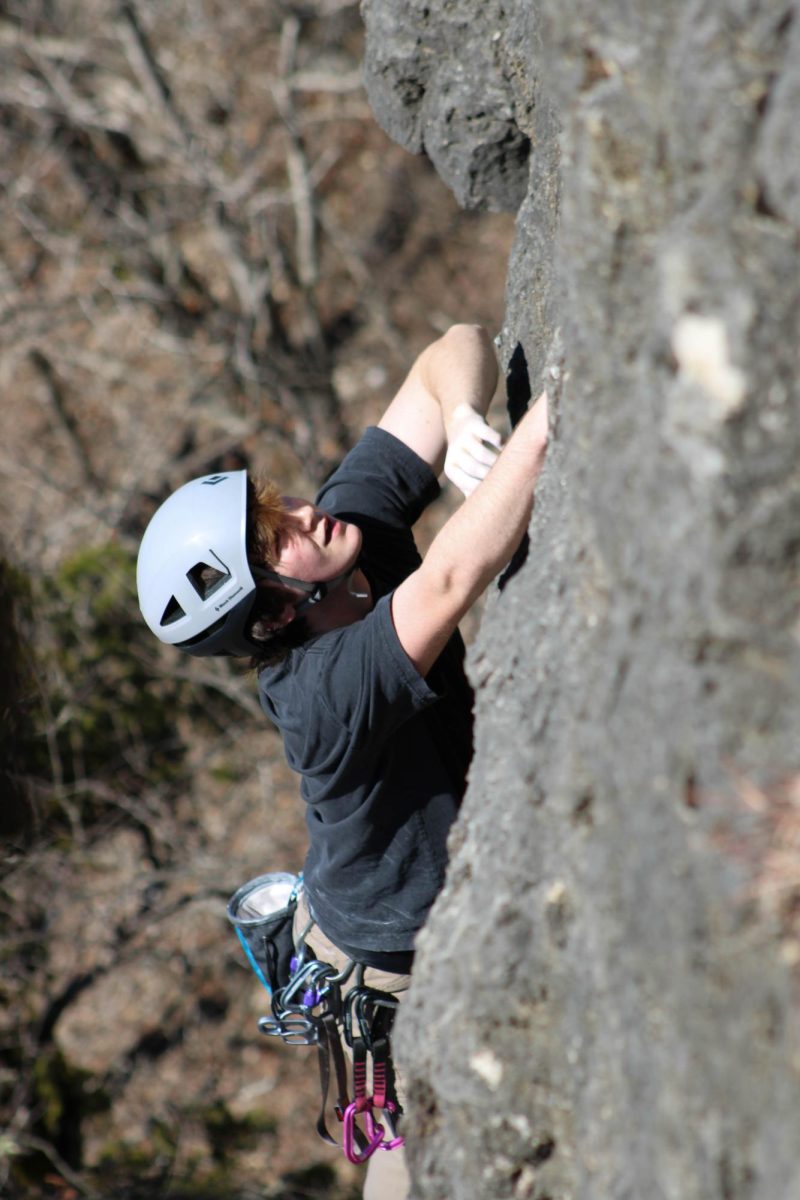
Almost every week, two Rolla High School students take a trek through winding dirt paths, steep rock stairways, and twisting tree branches. They set up ropes and anchors, pull on their special harnesses and shoes, and attempt to take on the outdoors.
Axton Gibbs and Andrew Thimgan are current high school seniors and avid rock climbers. They began practicing the extreme sport in the summer of 2024, when Thimgan invited Gibbs to a climbing gym in St. Louis. After workshopping in the gym for a while, they eventually moved on to natural bluffs.
“You’re working on building technique in the gym, and you’re transferring those skills outside, which is a lot more free form,” Gibbs said.
Gibbs and Thimgan practice two different climbing styles. They do top roping, where an anchored rope is already placed at the highest point of a cliff and the climber works with a belayer, who gives or takes slack. They also do lead climbing, where a climber places anchors as they move upward.
“You have the one person that leads place the protection, and then climbs up above to the next bolt and places after that. Once you get to the top and you build an anchor, you rappel down and collect all the pieces of pro that you’ve placed…Then you can just belay by pulling and taking out slack, rather than giving them slack. You basically catch them,” Thimgan said when describing lead climbing.
With high bluffs reaching far beyond the ground below, climbing can easily become a daunting experience. Training and trust are necessary for climbing safety. Gibbs and Thimgan rely on each other and their mutual bond to tackle each cliff.
“I think you would only do it with someone you really trust, because you wouldn’t want someone to have complete control over whether or not you fall. You wouldn’t want some random [person] to decide whether you live or die…So I would say, having a bond between you and your climber [and] belayer is pretty important,” Gibbs said.
It is also important for climbers to maintain a calm mindset while on the rocks.
“Whenever I’m climbing, I get into a kind of…flow state, almost, where I’m really in the zone while I’m doing it. I don’t ever really think about anything other than the climbing that I’m actively doing…I’m entirely focused on it,” Gibbs said.
Climbing requires not only mental fortitude, but also athleticism.
“You’re moving a lot of your own body weight. But then again, there’s a lot of technique and flexibility involved. And then that, coupled with the strength of small holds, whether it be footholds or handholds, [requires] a lot of grip strength,” Thimgan said.
Through its many challenging factors, climbing has helped Gibbs and Thimgan push themselves as athletes and problem-solvers.
“I think it’s the presentness and the sense of accomplishment you get from [it]. Because a lot of times when you’re climbing, you feel like you suck because you fall and you fail, but then you sort of push past it and finally achieve something that you’ve been projecting for a while,” Thimgan said.